

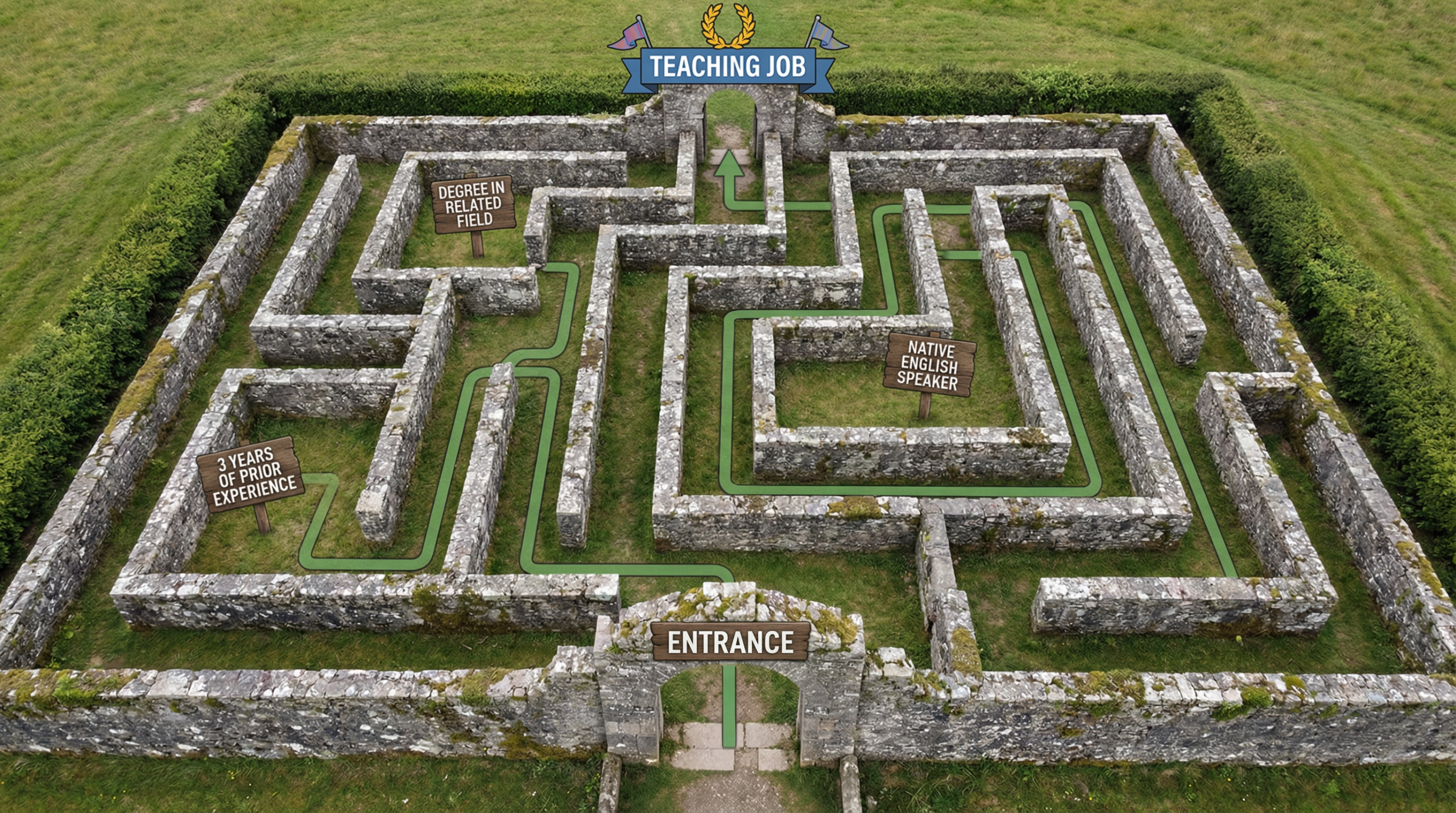
For expatriates seeking to teach English in Vietnam, the path to legal employment often feels like navigating a labyrinth of conflicting advice, outdated forum posts, and bureaucratic hurdles. The confusion stems not from a lack of laws, but from the complex interplay between two powerful government bodies: the Ministry of Labor, Invalids and Social Affairs (MOLISA) and the Ministry of Education and Training (MOET).
This article provides a definitive breakdown of the current legal landscape as of late 2023 and 2024. By examining the specific decrees and circulars that govern foreign labor, we will clarify the “Standard Combination” of requirements, the legal reality of “native speaker” status, and what these regulations mean for your work permit application.
The Dual-Ministry Challenge: Labor vs. Education
The most fundamental misunderstanding among foreign teachers is the belief that satisfying one set of requirements automatically satisfies all legal obligations. In reality, a foreign teacher must simultaneously satisfy two distinct masters:
- MOLISA (The Labor Ministry): Controls your right to work in Vietnam via the Work Permit. Their primary concern is proving you are a qualified “Expert” or “Technical Worker” who brings skills that local workers lack.
- MOET (The Education Ministry): Controls your right to teach via Education Standards. Their primary concern is pedagogical quality and ensuring teachers meet the academic standards set for educational institutions.
The “Standard Combination” of requirements—often cited as a Bachelor’s Degree, 3 years of experience, and a TEFL certificate—is actually a composite requirement derived from satisfying both ministries at once.
1. The Work Permit: The 3-Year Experience Rule (MOLISA)
The Work Permit is the golden ticket for legal employment. It is issued by the provincial Department of Labor, Invalids and Social Affairs (DOLISA). The governing law for this is Decree No. 152/2020/ND-CP, which was significantly amended by Decree No. 70/2023/ND-CP in September 2023.
Under these decrees, most foreign teachers are categorized as “Experts” (Chuyên gia). The legal definition of an expert is strict. According to Article 1, Clause 1 of Decree 70/2023/ND-CP (amending Article 3 of Decree 152), an expert is defined as someone who:
“a) obtains at least a bachelor’s degree or equivalent and at least 3 years’ experience in corresponding with the job position that he/she will be appointed in Vietnam.”
This single sentence is the source of the controversial “3-year experience” rule. It is a statutory requirement for the “Expert” category. Crucially, the experience must be “corresponding with the job position.” If you are hired as an English Teacher, your 3 years of experience must be in teaching or education. Working for 3 years as a barista or accountant does not count toward this requirement, even if you have a degree.
2. The Teaching Standard: The Certificate Rule (MOET)
While MOLISA cares about your experience, MOET cares about your qualifications. The primary document governing foreign language centers is Circular No. 21/2018/TT-BGDDT.
Article 18 of this Circular sets the standard for foreign teachers. It mandates that to be eligible to teach, a foreigner must possess:
- A college degree or higher (Bachelor’s is standard).
- A “suitable foreign language teaching certificate” (such as TEFL, TESOL, or CELTA).
Notice what is missing: Circular 21 does not explicitly require 3 years of experience. From MOET’s perspective, a fresh graduate with a degree and a CELTA is academically qualified to teach.
The Intersection: Why You Need Both
This is where the confusion arises. You might be academically qualified to teach (per MOET) but legally unqualified to get a work permit (per MOLISA) because you lack the 3 years of experience. Conversely, you might have 10 years of experience (per MOLISA) but lack a TEFL certificate (per MOET), making you ineligible to teach at a licensed center.
In practice, DOLISA (the Labor Department) acts as the gatekeeper. When you apply for a work permit as a teacher, DOLISA checks your “Expert” status. They require:
- The Degree: To satisfy the “University degree” requirement of Decree 70.
- The Experience: To satisfy the “3 years experience” requirement of Decree 70.
- The Teaching Certificate: To prove your technical expertise in the specific field of teaching, effectively enforcing MOET’s standard as part of the labor application.
Thus, the “Standard Combination” is born: Degree + 3 Years Experience + TEFL Certificate.
The “Native Speaker” Myth: Law vs. Practice
Another area rife with confusion is the definition of a “native English speaker.” Many job advertisements explicitly ask for candidates from the “Big 7” countries: the UK, USA, Canada, Australia, New Zealand, Ireland, and South Africa. But is this list actually written in the law?
The Legal Reality
The short answer is no. Neither Decree 70, Decree 152, nor Circular 21 contains a statutory list of “native English speaking countries.” The law is far less specific.
Circular 21/2018/TT-BGDDT, Article 18 distinguishes between two types of foreign teachers:
- Native Speakers (Clause 5): “A foreigner is eligible for teaching their native language when they possess at least a college degree and a suitable foreign language teaching certificate.”
- Non-Native Speakers (Clause 6): “A foreigner is eligible for teaching a foreign language when they… [possess] at least a level 5 certificate of language proficiency… and a suitable foreign language teaching certificate.”
The law uses the term “native language” (ngôn ngữ bản ngữ) but does not define it by passport. This ambiguity creates a gap that is filled by administrative practice.
The “Big 7” Administrative Rule
In the absence of a legal definition, immigration and labor officials use the “Big 7” list as a rule of thumb or administrative guideline.
- If you hold a passport from a Big 7 country: Officials generally accept you as a “native speaker” under Clause 5. You are exempt from providing a language proficiency test score.
- If you hold a passport from another country: Even if you are fluent, officials typically classify you under Clause 6. This means you must provide a Level 5 Proficiency Certificate (equivalent to C1 level, such as IELTS 7.0+) in addition to your degree and TEFL.
This distinction is crucial because it explains why “non-native” teachers face higher hurdles. It is not that they are legally banned from teaching; rather, they face an additional documentation requirement (the proficiency test) that “native” speakers are administratively exempted from.
The “New” Training Pathway: Decision 4159
In late 2023, MOET issued Decision No. 4159/QD-BGDDT, which introduced a standardized training program for foreign teachers. This decision was widely misunderstood as a new “restriction,” but it is actually an enabling regulation.
Previously, there was ambiguity about what constituted a “suitable” teaching certificate. Decision 4159 creates a formal, government-approved training curriculum (160 periods) for foreigners who have a degree but lack a pedagogical background. Completing this program grants a “Certificate of Training Completion,” which officially satisfies the teaching certificate requirement of Circular 21. It provides a clear, state-sanctioned pathway for compliance, reducing the risk of a generic online TEFL certificate being rejected by a strict local official.
Summary: What This Means for You
For an expat looking to teach in Vietnam today, the landscape is stricter but clearer than in the “wild west” days of the past. Here is the checklist for a smooth Work Permit application:
| Requirement | Source Law | Notes |
|---|---|---|
| Bachelor’s Degree | Decree 70 & Circular 21 | Required by both Labor and Education ministries. |
| 3 Years Experience | Decree 70 (MOLISA) | The biggest hurdle. Must be relevant experience (teaching). |
| Teaching Certificate | Circular 21 (MOET) | TEFL/TESOL/CELTA. Required to prove “Expert” qualification. |
| English Proficiency | Circular 21 (MOET) | Waived for “Big 7” passports (Administrative practice). Required (C1/Level 5) for others. |
| Criminal Record | Decree 152 | Must be clean. |
| Health Check | Decree 152 | Must be from an approved hospital in Vietnam. |
Final Advice
Do not rely on anecdotes from teachers who arrived five years ago. The enforcement of Decree 70 is rigorous. If you lack the 3 years of experience, you may face significant difficulties obtaining a standard “Expert” Work Permit, regardless of your teaching qualifications. Some employers may propose alternative visa routes or “internship” designations, but these often carry legal risks.
The most secure path is to ensure you have the “Standard Combination” of documents in hand before you arrive. In Vietnam’s current legal environment, paper is power.
References:
[1] Government of Vietnam. Decree No. 70/2023/ND-CP on amendments to Decree No. 152/2020/ND-CP. (2023).
[2] Ministry of Education and Training. Circular No. 21/2018/TT-BGDDT on organization and operation of foreign language centers. (2018).
[3] Ministry of Education and Training. Decision No. 4159/QD-BGDDT on training program for foreign teachers. (2023).

test
yo