Overview
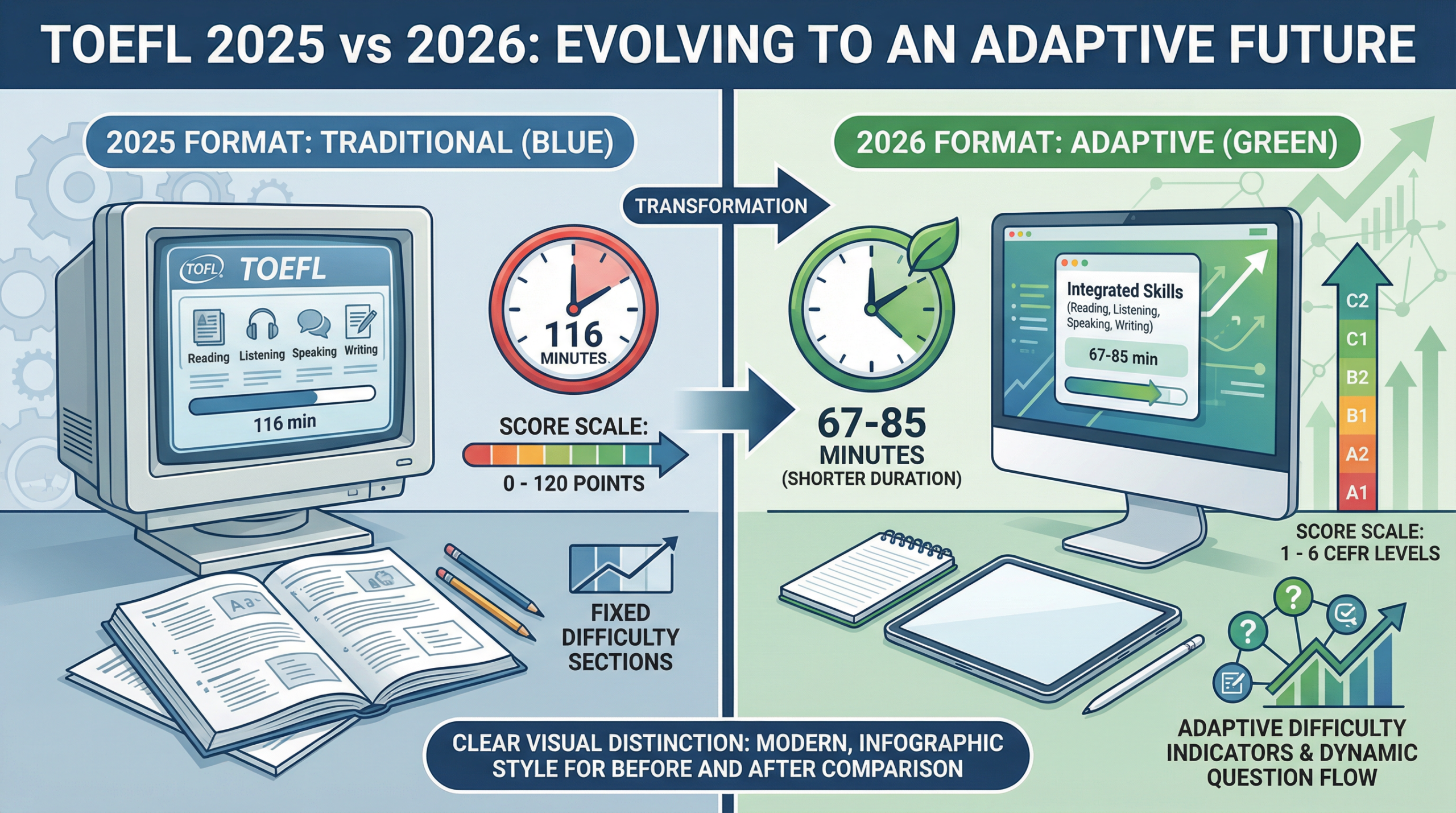
Starting January 21, 2026, the TOEFL iBT test will be updated with an adaptive test format, more relevant content, and a new scoring scale from 1-6 that aligns with the CEFR framework. The test duration will be reduced to 67-85 minutes from the current 116 minutes.
Reading Section
The current Reading section includes two passages, each approximately 700 words long, with 10 questions per passage, taking about 35 minutes to complete. Passages are excerpts from university-level textbooks covering various subjects.
In contrast, the 2026 Reading section will feature three different task types: Complete the Words (a fill-in-the-missing-letters task), Read in Daily Life (non-academic texts between 15-150 words like emails, text messages, memos, posters, menus, or invoices), and Read an Academic Text (approximately 200-word academic passages followed by five multiple-choice questions).
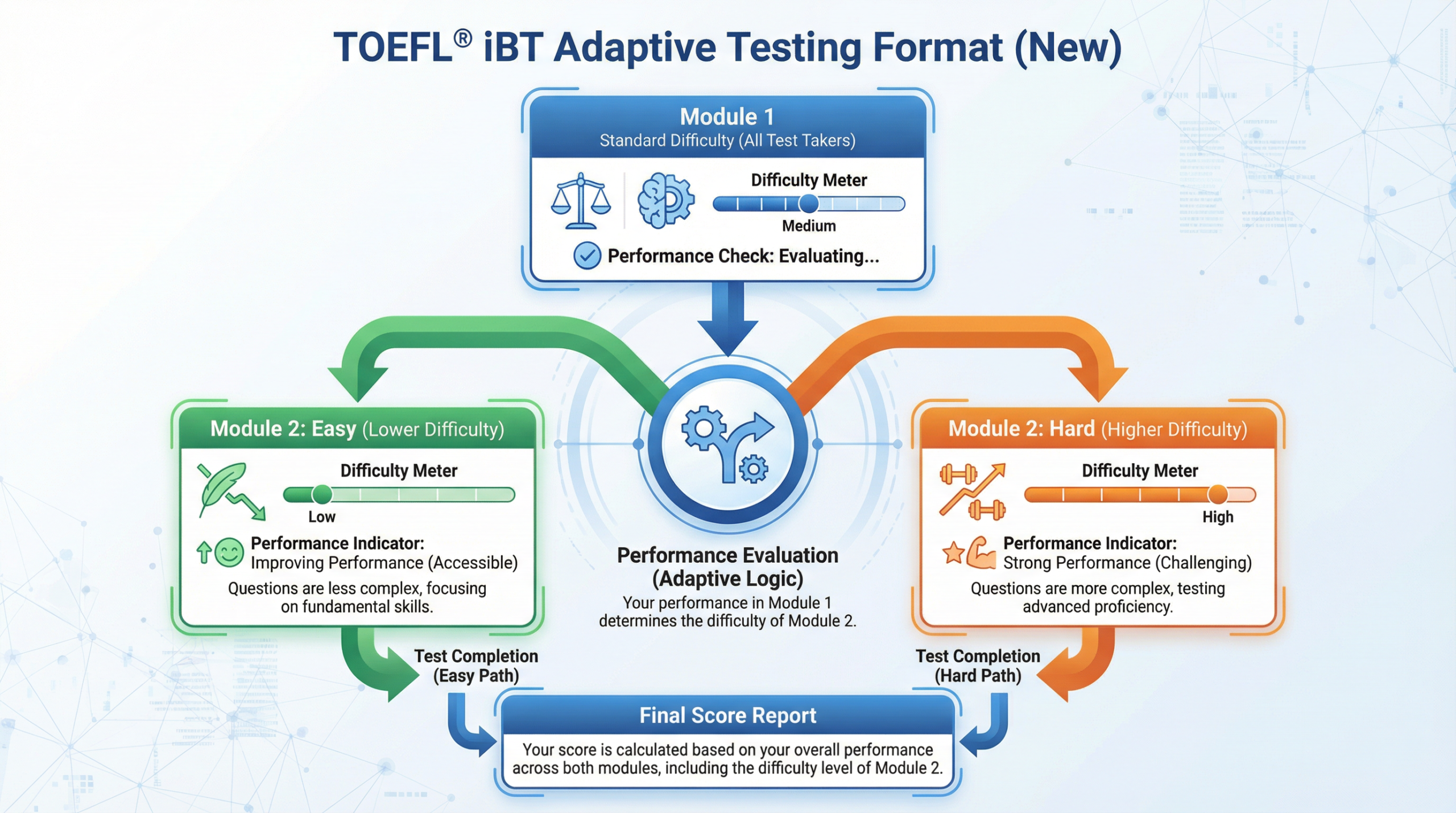
The new format represents a significant structural change. The 2026 section will include 35 to 48 questions total and will be spread across two adaptive modules, with the first module being the same difficulty for everyone and the second module adjusted to ‘hard’ or ‘easy’ based on first-module performance. This adaptive approach differs fundamentally from the current format’s static structure, where all test-takers encounter the same level of difficulty.
Current Format (2025) vs New Format (2026)
| Current Format (2025) | New Format (2026) |
|---|---|
| Two passages (~700 words each) | Three task types with varied text lengths |
| 10 questions per passage | 35-48 questions total |
| University-level textbook excerpts | Mix of academic texts (~200 words) and daily-life materials (15-150 words) |
| All academic content | Includes Complete the Words, Read in Daily Life, and Read an Academic Text tasks |
| Static difficulty level | Two-module adaptive format |
| 35 minutes total | Time varies based on adaptive modules |
| 20 questions total | Question count varies (35-48) |
Listening Section
The current Listening section features 3 lectures and 2 conversations, totaling about 36 minutes, with 28 questions total. The section includes native-speaker English accents from North America, the UK, New Zealand, or Australia.
The 2026 version expands the range of listening tasks significantly. The new Listening section will include four task types: Listen and Choose a Response (hearing a single sentence and choosing the correct response from four choices), Listen to a Conversation (short conversations with ten turns), Listen to an Announcement (campus or classroom announcements), and Listen to an Academic Talk.
Similar to Reading, the Listening section’s most dramatic change involves adaptivity. The 2026 Listening section will use a multistage adaptive format spread across two modules, with the first module being the same difficulty for everyone and the second adjusted based on performance, with ‘hard’ modules emphasizing academic content and ‘easy’ modules emphasizing daily life content.
Current Format (2025) vs New Format (2026)
| Current Format (2025) | New Format (2026) |
|---|---|
| 3 academic lectures | Four task types with varied formats |
| 2 conversations | Listen and Choose a Response tasks |
| 28 questions total | Listen to a Conversation (ten turns) |
| 36 minutes total | Listen to an Announcement tasks |
| Static format for all test-takers | Listen to an Academic Talk tasks |
| Focus on lectures and conversations | Two-module adaptive format |
| Native English accents (North America, UK, New Zealand, Australia) | ‘Hard’ modules emphasize academic content; ‘easy’ modules emphasize daily life content |
| No adaptive difficulty | Difficulty adjusts based on first-module performance |
Speaking Section
The current Speaking section includes four questions taking about 17 minutes: one Independent Speaking Task requiring test-takers to draw on their own ideas and opinions, and three Integrated Speaking Tasks requiring combinations of listening and speaking or listening, reading, and speaking. Test-takers receive 15-30 seconds of preparation time before each response, and responses are 45 or 60 seconds long.
The 2026 format represents a complete overhaul of this section. The new Speaking section will eliminate all current task types and introduce two new formats: Listen and Repeat (test-takers listen and repeat seven sentences about campus or daily life topics) and Take an Interview (test-takers answer four questions about a given topic with 45 seconds per answer).
A critical distinction between the formats involves preparation time. While the current format provides test-takers with time to organize their thoughts before speaking, the 2026 format provides no preparation time for either task, requiring test-takers to speak spontaneously. This shift emphasizes real-time verbal fluency over planned responses.
Current Format (2025) vs New Format (2026)
| Current Format (2025) | New Format (2026) |
|---|---|
| Four questions/tasks | Two task types |
| One Independent Speaking Task | Listen and Repeat (7 sentences) |
| Three Integrated Speaking Tasks | Take an Interview (4 questions) |
| 15-30 seconds preparation time | No preparation time |
| 45-60 second responses | 45 seconds per interview answer |
| Combines reading, listening, and speaking | Seven repetition tasks about campus/daily life |
| 17 minutes total | No reading component |
| Tests planned responses | Tests spontaneous speaking ability |
| All four traditional task types included | Complete elimination of all previous task formats |
Writing Section
The current Writing section takes about 29 minutes and includes two tasks: the Integrated Writing Task (20 minutes) requiring test-takers to read a short passage and listen to a short lecture, then write in response to both, and the Writing for an Academic Discussion task (10 minutes) requiring test-takers to state and support an opinion in an online classroom discussion.
The 2026 format modifies this structure significantly. The new Writing section will include three task types: Build a Sentence (unscrambling mixed-up sentences from exchanges between students), Write an Email (seven minutes to write an email regarding a specific scenario), and Writing for an Academic Discussion (the same 10-minute task as the current format, writing a post on a class discussion board).
The most notable change involves the removal of the traditional integrated task. The Integrated Writing Task will be eliminated from the 2026 format, meaning test-takers will no longer need to synthesize information from a reading passage and lecture into a formal essay. Instead, the new format introduces more practical, real-world writing tasks like email composition and sentence construction, while retaining only the Academic Discussion task from the current version.
Current Format (2025) vs New Format (2026)
| Current Format (2025) | New Format (2026) |
|---|---|
| Two writing tasks | Three writing tasks |
| Integrated Writing Task (20 minutes) | Build a Sentence (unscramble mixed-up sentences) |
| Read passage and listen to lecture | Write an Email (7 minutes) |
| Write essay synthesizing both sources | Writing for an Academic Discussion (10 minutes) |
| Writing for an Academic Discussion (10 minutes) | No reading and listening integration task |
| 29 minutes total | Approximately 23 minutes total |
| Tests formal academic essay writing | Tests sentence construction and practical email writing |
| Requires synthesis of reading and listening | Emphasizes real-world communication scenarios |
| Both tasks scored 0-5 | Academic Discussion task retained from current format |
Scoring
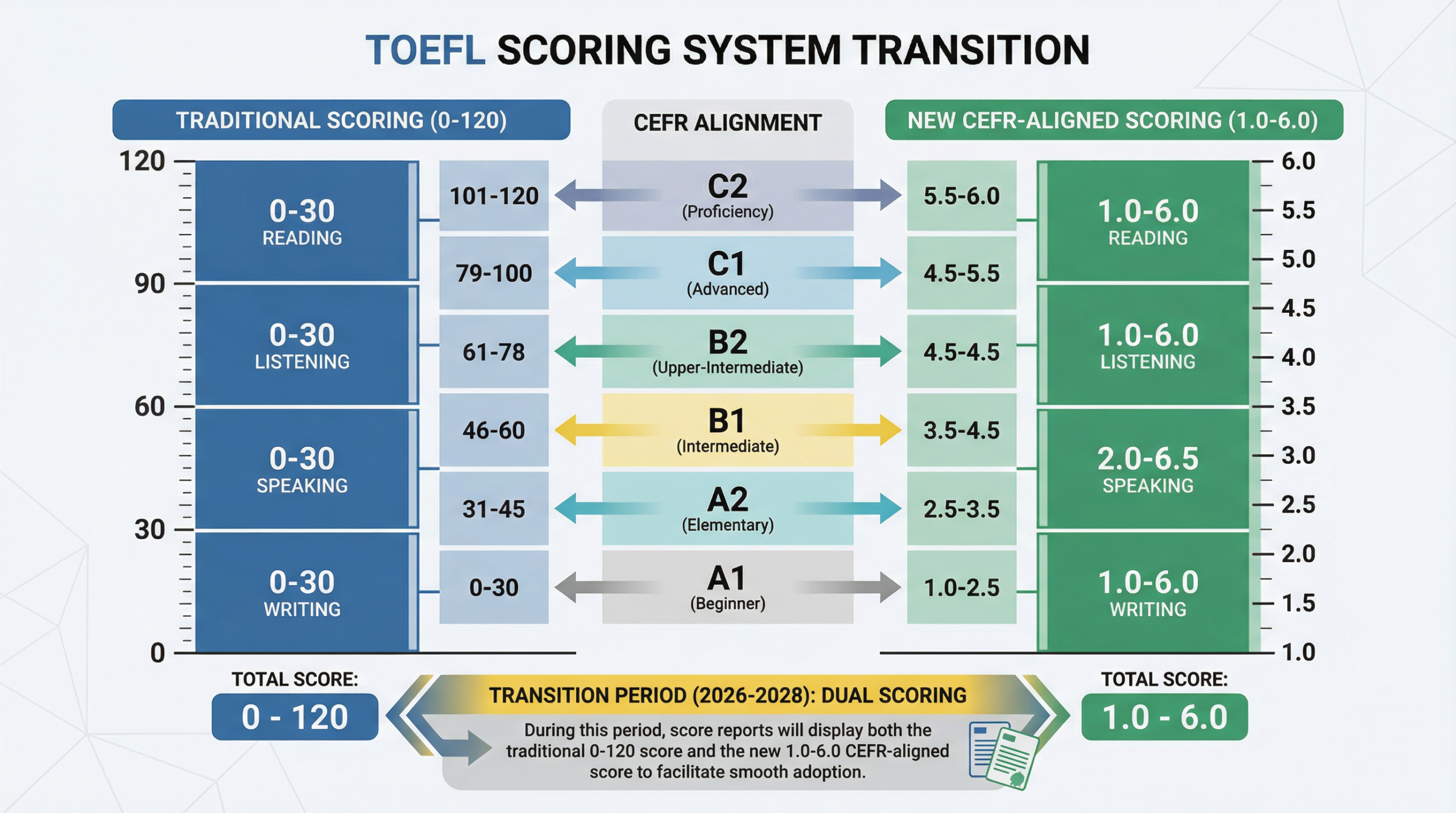
The current TOEFL iBT is scored on a scale of 0-120, with each of the four sections scored from 0-30. The 2026 format introduces a fundamentally different scoring system.
Starting January 21, 2026, test-takers will receive four section scores and an overall score on a 1-6 scale with half-point increments, aligned with the CEFR framework. To facilitate the transition between systems, for a two-year transition period after January 2026, students will also receive a comparable overall score on the 0-120 scale. This dual-scoring approach allows both test-takers and institutions to compare results across the old and new formats during the adjustment period.
Current Format (2025) vs New Format (2026)
| Current Format (2025) | New Format (2026) |
|---|---|
| 0-120 total score scale | 1-6 overall score scale |
| Each section scored 0-30 | Each section scored 1-6 |
| Four section scores combined | Half-point increments allowed (e.g., 4.5, 5.5) |
| No CEFR alignment indicated | Aligned with CEFR framework |
| Single scoring scale | Dual scoring during transition (2026-2028) |
| Standard since test inception | 0-120 comparable score provided for two years |
| Widely understood by institutions | Overall score is average of four sections |
| Integer scores only | Scores rounded to nearest half band |